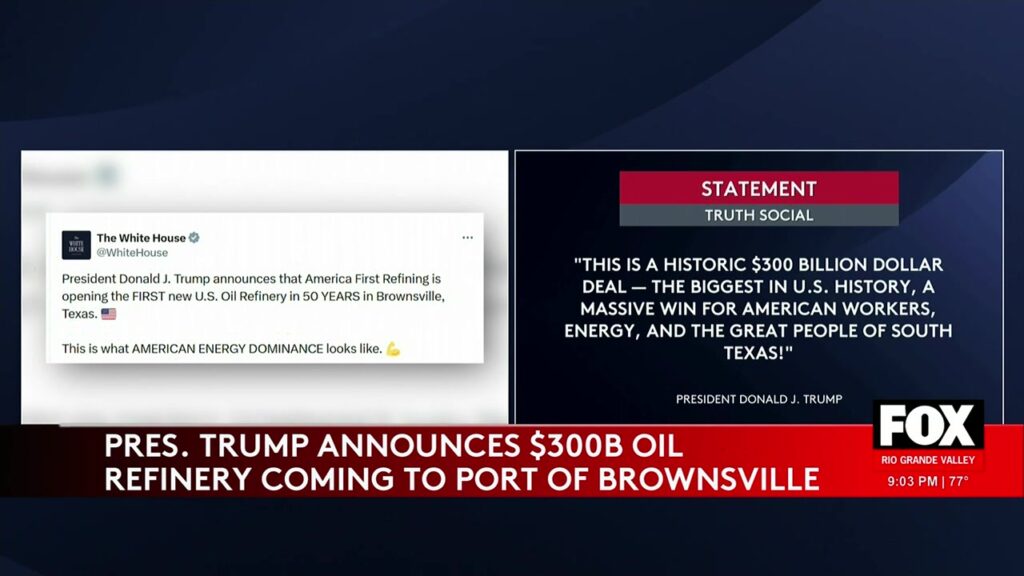
Earlier today, former President Donald Trump made headlines with the announcement of a planned $300 billion oil refinery project at the Port of Brownsville, Texas. This declaration, made through his Truth Social account, has captured the attention of both local residents and the broader American public. Trump presented the refinery initiative as a substantial victory for American workers and an economic boon for South Texas, an assertion that aligns with his longstanding advocacy for domestic energy production.
The project, which is expected to become the first newly constructed refinery in the United States in half a century, marks a notable milestone in the nation's energy landscape. This move could considerably impact America's energy strategy, particularly in efforts to increase energy production independence from international sources.
Investment Details
The proposed refinery is being developed in collaboration with a multinational energy company based in India, highlighting the project's international significance and the commitment to investing in American infrastructure. This involvement underscores the global nature of energy markets and the strategic partnerships that can be formed across borders. While the specifics of the investment have not been detailed extensively, the $300 billion price tag suggests a significant infusion of capital that could stimulate the local and national economy.
The choice of the Port of Brownsville as the site for this new facility is strategic due to its proximity to Mexican oil production areas and its access to shipping lanes that facilitate global trade. Additionally, the port's location in South Texas is advantageous for logistical operations, ensuring the efficient transport of refined goods both nationwide and internationally.
Impact on Local Economy
The establishment of the refinery is poised to have a profound impact on Brownsville's local economy. It is expected to create numerous construction jobs and long-term positions within the refinery operations, thereby providing significant employment opportunities for residents of the region. An influx of job opportunities can lead to increased economic activity, fostering local business growth and contributing to regional prosperity.
Beyond the immediate job creation, the refinery could also support the broader energy sector in Texas, which has in recent years been a major driver of economic growth in the state. The refinery's operations may encourage ancillary businesses and service providers to establish themselves in the area, further boosting the economic profile of Brownsville and the surrounding region.
While there is potential for positive economic impacts, it is crucial to address the environmental and regulatory considerations accompanying such a large-scale project. Residents and stakeholders will need assurance that environmental standards are rigorously upheld to mitigate any adverse effects on the local ecosystem and community health.
Political Implications
The timing of this announcement is noteworthy, as it coincides with ongoing national debates surrounding energy policies and environmental concerns. In recent years, discussions have intensified regarding the balance between expanding domestic energy production and addressing climate change. Trump's high-profile announcement underscores the ebb and flow of political discourse in the realm of energy policy.
This project may influence future discussions on the regulatory frameworks governing energy production, potentially prompting new legislation or adjustments to existing policies. As such, it represents a pivotal moment in the interplay between political ambitions, environmental stewardship, and economic interests.
Perhaps more broadly, this development could symbolize the ongoing tensions between nationalist economic policies and globalization's role in providing resources and investments. The collaboration with the Indian energy company is testament to the interconnectedness of global markets and the complexities of achieving energy independence while participating in international partnerships.
Additional Resources
For further information about energy projects and policy updates, visit the U.S. Department of Energy’s website.