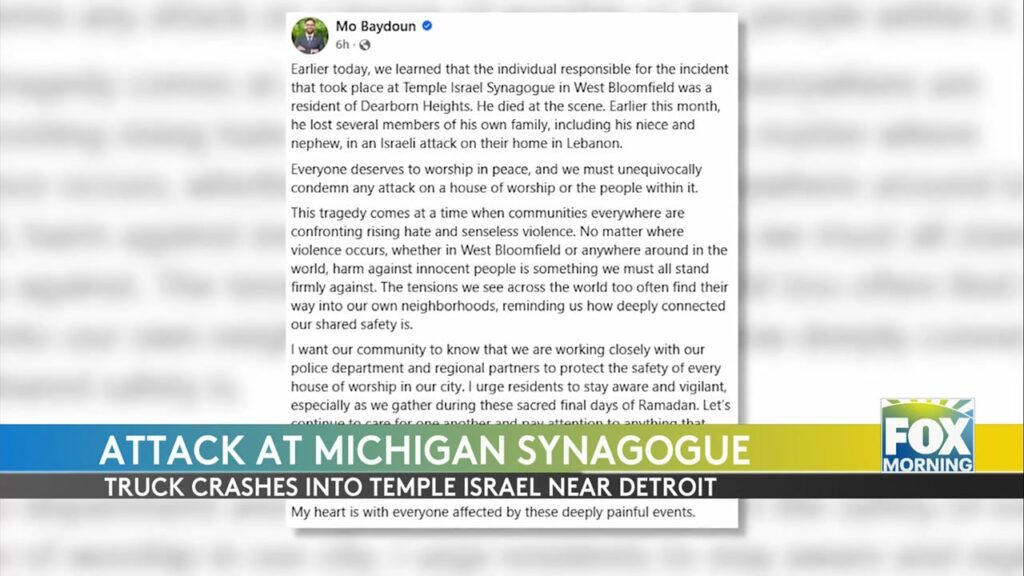
An attack on Temple Israel, a prominent synagogue located near Detroit, has sparked an intense investigation into the motives behind the incident. The suspect, who was ultimately killed by security personnel, was identified as a naturalized citizen from Lebanon. This event unfolds within the context of ongoing geopolitical tensions in the Middle East, casting a spotlight on potential international influences.
The attack occurred amidst a busy Thursday, with law enforcement quickly arriving on the scene. In the aftermath, local communities and religious organizations have been reassessing their security strategies while grappling with the shock and implications of the attack.
The Violent Incident
The suspect, reportedly armed with a rifle, drove a truck into Temple Israel, causing significant damage and widespread panic. This violent act unfolded at a site that not only serves as a religious hub but also operates a preschool, with over 100 children attending. Remarkably, despite the chaos, no children or staff were harmed. The incident underscores the crucial role of the synagogue’s security team, whose rapid response curtailed what could have been an even more tragic outcome.
Eyewitnesses recounted moments of terror as the truck rammed into the synagogue. "I heard a loud crash and saw some debris," one staff member noted. "I heard a bang, which was a shot, and immediately gathered the staff members around me. We ran into my office for cover." This testimony highlights the gravity of the situation and the immediate danger posed to those present.
Investigative Developments and Suspect Background
Investigators have been working diligently to decipher the motives behind the attack, delving into the suspect's background. Authorities revealed that the suspect recently endured the loss of several family members in Lebanon, reportedly due to an Israeli military strike. Given this personal history, there is speculation that the attack could have been perpetrated as retaliation, driven by the suspect's grief and political dissatisfaction. Such personal grievances tied to broader Middle Eastern conflicts are a focal point of the ongoing investigation, as officials seek to understand the full array of factors at play.
In exploring these motivations, law enforcement remains vigilant, considering both personal and political influences that might have fueled the suspect's actions. The case has prompted heightened scrutiny and a deeper examination of the potential for similar politically charged incidents.
Community and Law Enforcement Reactions
The attack has sent ripples throughout the West Bloomfield community, prompting a renewed conversation about the security of religious spaces. Synagogues, in particular, have been urged to reevaluate their security protocols. Community leaders and local law enforcement agencies are discussing collaborations to bolster safety measures, seeking ways to prevent potential threats while reassuring congregants and residents.
The decisive action taken by Temple Israel's security personnel is widely praised as a factor that prevented further escalation. Their quick intervention provided a critical buffer, allowing additional protective measures to be activated across local religious and community centers.
In the wake of this incident, there is a push for comprehensive safety training initiatives aimed at equipping places of worship with the tools and knowledge needed to respond to emergencies effectively. These efforts are part of a broader initiative to enhance community resilience against such threats.
Additional Resources
For communities and organizations seeking further information on security preparedness and best practices, resources are available through the Federal Emergency Management Agency (FEMA). Their guidelines offer valuable insights for planning, response, and recovery in disaster scenarios, which can be adapted for various types of security threats.