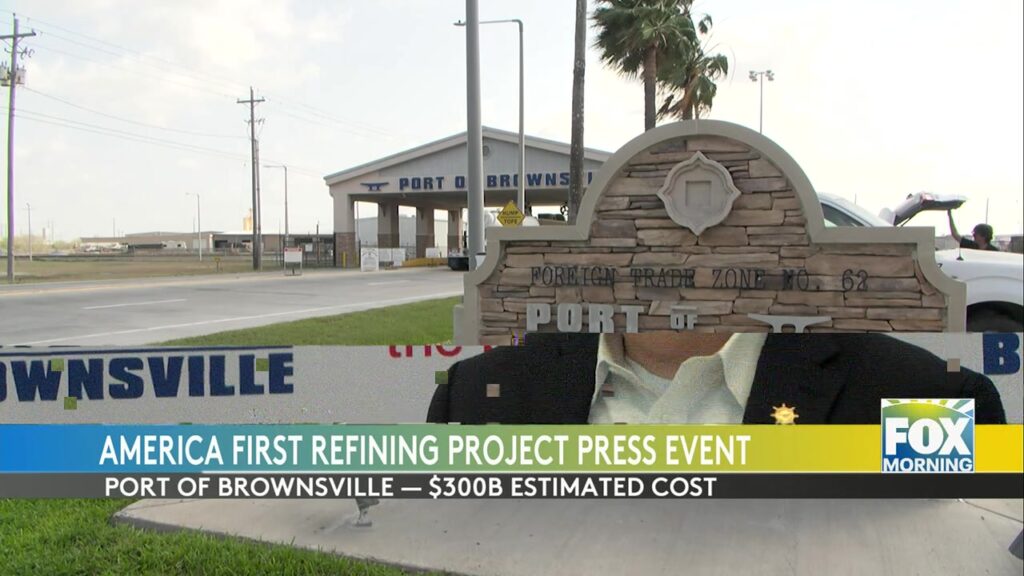
The Port of Brownsville has recently garnered significant attention, spurred by the announcement of a large-scale industrial initiative: the America First Refining Project. This ambitious venture marks a milestone in the United States energy sector, being the first new oil refinery to open in the country in over 50 years. The press conference held on Wednesday served as a platform to unveil further details, highlighting the substantial impact this project is anticipated to have on both the local and state economy.
Endorsed by Reliance Industries, a leading multinational energy company headquartered in India, the project involves a colossal investment of approximately $300 billion. The implementation of this project not only signals economic revitalization for Brownsville, Texas, but also positions the region as a pivotal player in the energy landscape of the United States.
Details of the Refinery
Set to occupy a sprawling 240-acre site at the Port of Brownsville, the new refinery is championed as a model of innovative advancement in clean technology. Significantly diverging from the traditional image of smoke-belching refineries, this facility emphasizes the integration of advanced emission controls aimed at drastically reducing environmental impact. Officials assert that the refinery will be the cleanest of its kind globally, incorporating state-of-the-art technologies to minimize its ecological footprint.
The project's visionary approach aligns with growing trends in the energy industry to merge profitability with environmental responsibility. Its design reflects contemporary engineering achievements intended to lead by example in sustainable industrial development.
Economic Opportunities
The economic ramifications of the America First Refining Project are expected to ripple throughout the Rio Grande Valley and beyond. Brownsville leaders and local authorities have expressed optimism about the prospective economic benefits the project will deliver. The construction phase alone is projected to create approximately 1,400 jobs, thereby acting as a substantial employment source during development. Moreover, once operational, hundreds of permanent jobs are anticipated, offering diverse opportunities across various sectors.
Beyond job creation, the project promises to invigorate local businesses and stimulate additional investments in infrastructure and community services, potentially transforming Brownsville into a booming economic hub.
Opposition and Concerns
Despite its promising economic potential, the refinery project has faced considerable opposition. Environmental advocates and local residents have voiced concerns over the prospective environmental ramifications. A particular emphasis has been placed on the dangers of water resource depletion and ecosystem disruption. The situation in nearby Corpus Christi is often referenced by environmentalists as a cautionary precedent, where industrial demands have historically strained local water supplies.
In response to these concerns, stakeholders have been urged to conduct comprehensive environmental assessments and implement robust mitigation strategies. The debate has highlighted the essential balance between fostering economic growth and preserving environmental integrity.
Community Engagement and Future Implications
Given the ongoing controversy, active community engagement has become a crucial component of the project's strategy. Proponents have emphasized the importance of transparent communication and collaboration with local communities to address environmental and employment concerns. Public forums and meetings are anticipated to facilitate dialogue, ensuring that community voices are integrated into the project's ongoing development.
The America First Refining Project stands at the intersection of innovation and controversy, with its future ramifications likely to influence policy and practice within the industry. While economic benefits are apparent, the broader implications on local ecosystems and community dynamics remain under close scrutiny. As the project progresses, the ongoing discourse may shape future standards for industrial development across the United States.
Additional Resources
For further information on oil refinery regulations and environmental concerns, visit epa.gov.